All the knowledge that humanity has can be traced back to the creation or use of tools. As a species, we evolved intelligence so we could construct wood and stone tools for survival, and our first knowledge was the generational learning of how these are made and used. Eventually, we were able to branch out into more diverse tools made of more diverse materials, which led to more creative technologies for communication and transportation. Over time, humans fashioned even better tools and innovated on those that existed, bringing us to a modern world where sometimes a tool is more a source of inspiration than useful for its original purpose. This exhibition will examine three artifacts representing each of these roles of tools in the acquisition of knowledge—to communicate, to transport, and to inspire. However it is used, every tool has a story and represents the knowledge of its invention, its use, its innovation, and its cultural significance.

The Rosetta Stone is famous for being a symbol of communication through space and time, of archaeology and ancient language. In historical study, its main use has been to decipher the ancient Egyptian scripts it uses. It has a long and storied history and is now housed in the British Museum in London. The royal decree on it was etched around 2000 years ago, most likely using stone chisels and similar implements. For two millennia, the product of these tools has served as a source of knowledge: it told ancient Egyptians of their new king, and it has helped countless (mostly European) historians and other researchers, in more recent times, learn about Egypt and its writing systems of the time. As the Rosetta Stone continues to be studied, more tools are contributing to the body of knowledge it represents, such as the carbon-dating techniques used to ascertain its age. Since ancient times, humans have used tools of all kinds to write and draw anywhere and everywhere in order to communicate knowledge. Indeed, written text is now viewed as the primary method of acquiring knowledge and the easiest way to disseminate it; none of it would be possible without the tools that made the Rosetta Stone.
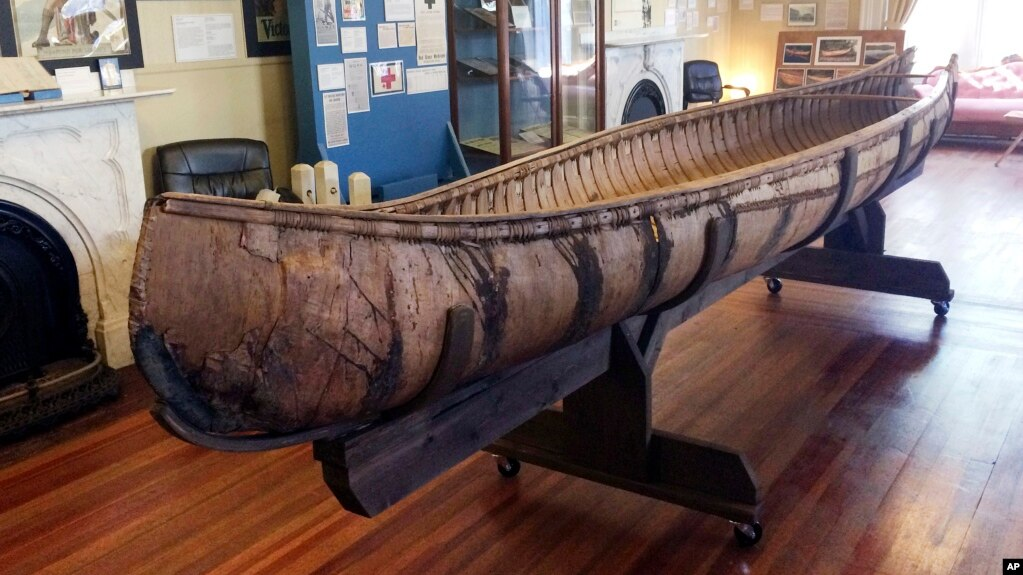
This canoe is one of the oldest known surviving birch-bark canoes made by American Indians. It was built in the mid-1700s by members of the Wabanaki nation of the North Atlantic coast. It was gifted to Capt. William Barnes and passed down in his family before being donated to the Pejepscot Historical Society in 1889. Canoes were vital to the lifestyle of indigenous peoples on both coasts of North America, used for transportation of goods of all sorts and of people, on long journeys that would be impossible on foot. For generations, peoples such as the Wabanaki made canoes like this one out of birch bark because it is light and flexible. When European settlers arrived, they observed the success in trade and transportation that was made possible by the use of such materials, and modeled their future canoe designs on the birch-bark canoes of the Atlantic coast nations. Thus, the tools of the Wabanaki produced for them the knowledge of how to build and use canoes, among all they learned about the world around them using these vessels. This knowledge was acquired to other societies over time, and now today we still recognize what the Wabanaki have known since time immemorial through modern variants of the same tools.
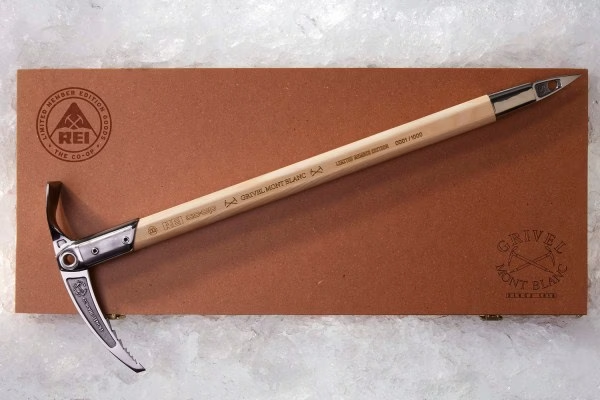
In 1935, husband and wife Lloyd and Mary Anderson of Seattle wanted to buy an ice axe, but could not afford a quality, locally-made one. Instead, they purchased an Austrian ice axe like this one and had it shipped to the U.S for a fifth of the cost. As they continued to do this, their friends in the area learned about this endeavor and each chipped in a small amount of money in order to bring down costs for all of them, and thus the Recreational Equipment, Inc. Co-operative was born in 1938. Today, the Andersons’ legacy is one of the largest and most popular cooperative organizations in the U.S., from which members nationwide have gained the knowledge necessary to keep themselves safe and happy in the outdoors. Simple tools, such as this ice axe, have served as inspiration for a growing number of people to seek the various forms of knowledge that can be acquired by getting out into nature, alone or with others. And it is not limited to knowledge of the outdoors: REI is one of the nation’s foremost cooperative retailers, meaning it is legally owned by its members, the consumers, rather than outside shareholders. If not for its existence, inspired by the Andersons’ ice axes in the 1930s, the idea of such a structure might be lost on many Americans.
Throughout history, technology has been inseparably intertwined with knowledge. From writing chiseled in stone, to wooden vessels in water, to metal breaking through ice; from a king controlling thousands of people in the desert, to economic activity spanning thousands of miles along a coastline and across the ocean, to a legal structure by which ordinary people control the sale of thousands of items daily; the tools that humanity has devised over thousands of years have given us immense power over our lives, the world, and each other. And, as we all know, knowledge is power—power is knowledge.
“Rosetta Stone” on Wikipedia,
en.wikipedia.org/
Patrick Whittle, “1 of oldest Native American birch-bark canoes now on display,” in
Associated Press,
apnews.com/
“REI History: It Started With An Ice Axe,”
rei.com/